Project

Project objectives

MARINER will develop and validate a modular 1 MW Polymer Electrolyte Membrane fuel cell system scalable to beyond 10 MW for fully H2-powered maritime transport.

The project will demonstrate the system’s performance in terms of:
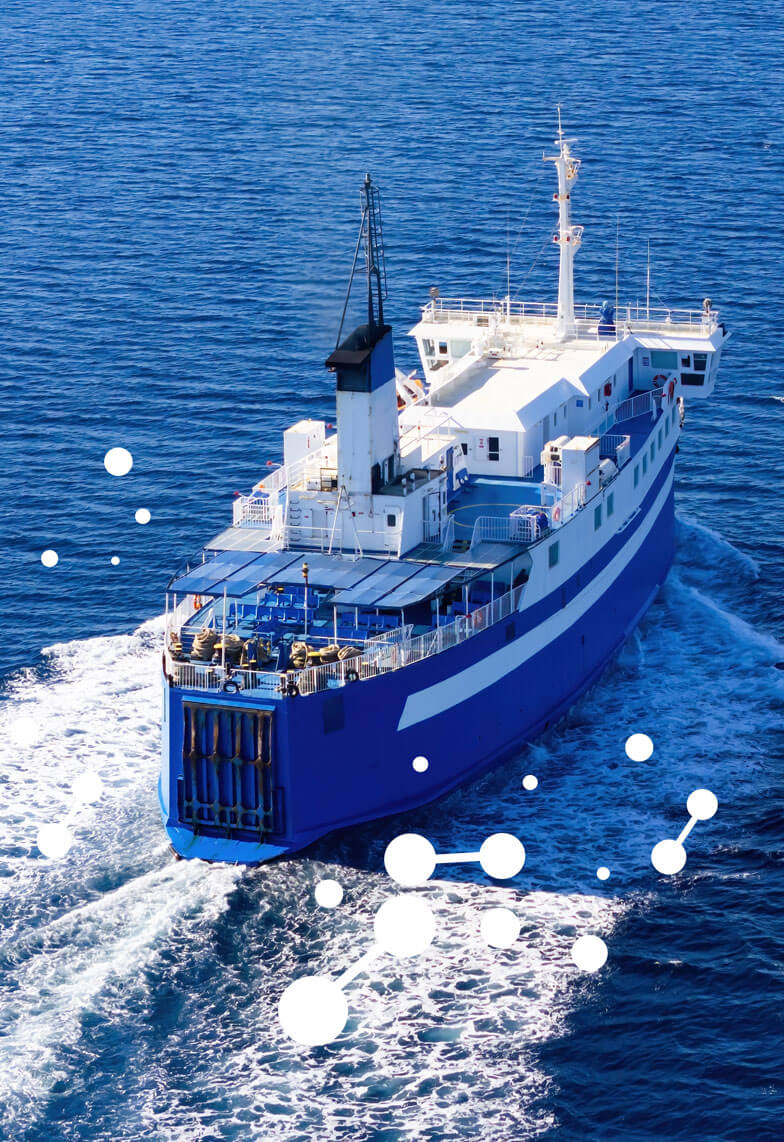
  • Efficiency and affordabilityBased on a standardised multi-stack design, shared auxiliary systems, innovative power architecture, and the use of off-the-shelf components

  • Safety and reliabilityThanks to health conscious control and a fault-tolerant energy management system enabling to operate in partial failure conditions

  • DurabilityThrough 1000+ hours of tests in simulated maritime conditions and accelerated stress testing equivalent to 40 000 hours of operation

  • Total cost of ownership and life cycle footprintIn two concrete contexts of tanker & high speed ferry end-uses

  • Industry-readinessthrough a class-reviewed protocol for Factory Acceptance Tests for faster certification.

Project objectives

Our targets in figures

Lower Heating Value Efficiency for 1 MW

≥ 55%

Lower Heating Value Efficiency for 1 MW

< €1,200/kW CAPEX for a1 MW system

≥ 55%

CAPEX for a1 MW system

> 60,000 hours lifetime demonstrated by degradation rate evidence

> 60,000 hours

lifetime demonstrated by degradation rate evidence

80,000 hours system lifetime through health-conscious control

80,000 hours

system lifetime through health-conscious control

Methodology

Our approach is structured in four components. The two development components respectively focus on (1) the fuel cell architecture, and (2) the simulation, control and monitoring tools. The third component deals with testing and validation, while the fourth is about paving the way to market uptake.
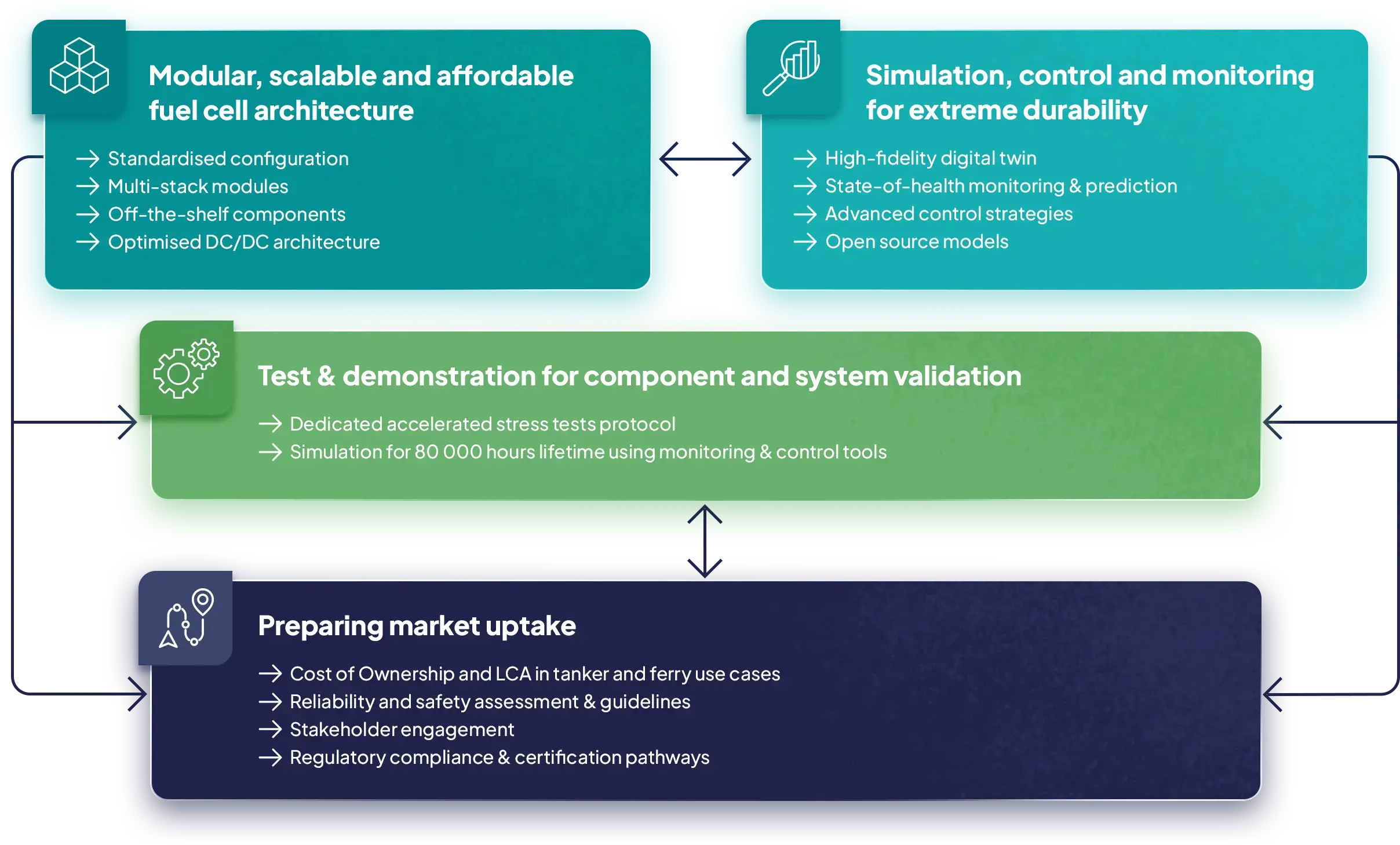

MARINER Methodology

We will design a standardized configuration based on multi-stack modules and associated Balance of Plant (BoP) equipment, that can be replicated up to 10 MW. Common stack frames, shared BoP elements, and the use of off-the-shelf components will allow to cut the costs. Efficiency will be increased through optimised system architecture, improved heat recovery, humidification control, and full hydrogen fuel recovery. An optimised modular DC/DC power conversion architecture will be developed with off-the-shelf DC/DC modules and validated with hardware-in-the-loop. We will build and test from lab-scale to a 1 MW fully integrated system in relevant conditions.

Our open-source modelling work will enable to create high-fidelity digital twins for different maritime use cases, with simulation of real-time degradation and accurate long-term performance assessment. A multi-level state-of-health framework will allow early detection of ageing. Advanced control strategies will be specifically tailored to maritime systems and validated on the integrated 1 MW system under maritime conditions.

We will design an Energy Management System able to control independently each module within the stack, and to reallocate power between modules in cases of problems, also considering their real-time and predicted state of health.

Two testing campaigns will demonstrate the performance and durability of the fuel cell: accelerated stress tests at the module scale and a simulated real conditions test at the full 1 MW scale.

At the unit module scale (~200 kW), a protocol for accelerated stress test (AST) will be specifically designed for the maritime context and implemented to validate the module’s durability.

To demonstrate the objective of 80 000 hours lifetime, MARINER will simulate the models validated by the AST and leverage the control and monitoring tools developed (see above).

Learn about the tests at MINES, CEA and SEC’s labs

Data from the tests will be used to evaluate the total cost of ownership and life cycle analysis of two use casesprovided by our ship operating partners in the tanker and ferry sectors. Specific attention will be paid to reliabilityand operational safety, with dedicated safety measures included in the design, and risk assessment on different accident scenarios. Regulatory compliance and certification pathways will also be proposed.

The open-source fuel cell models, monitoring and control algorithms will be integrated in the well-established VirtualFCS Modelica library.  Finally, a roadmap will prepare the scaling up to the 10 MW target, and synergies will be identified to reach other sectors such as road or stationary applications.

This work plan relies on the complementary expertise of our partners from science and industry: check the MARINER team here.